
UCEED Mental Rotation Practice: Train Your 3D Thinking Without Expensive Tools
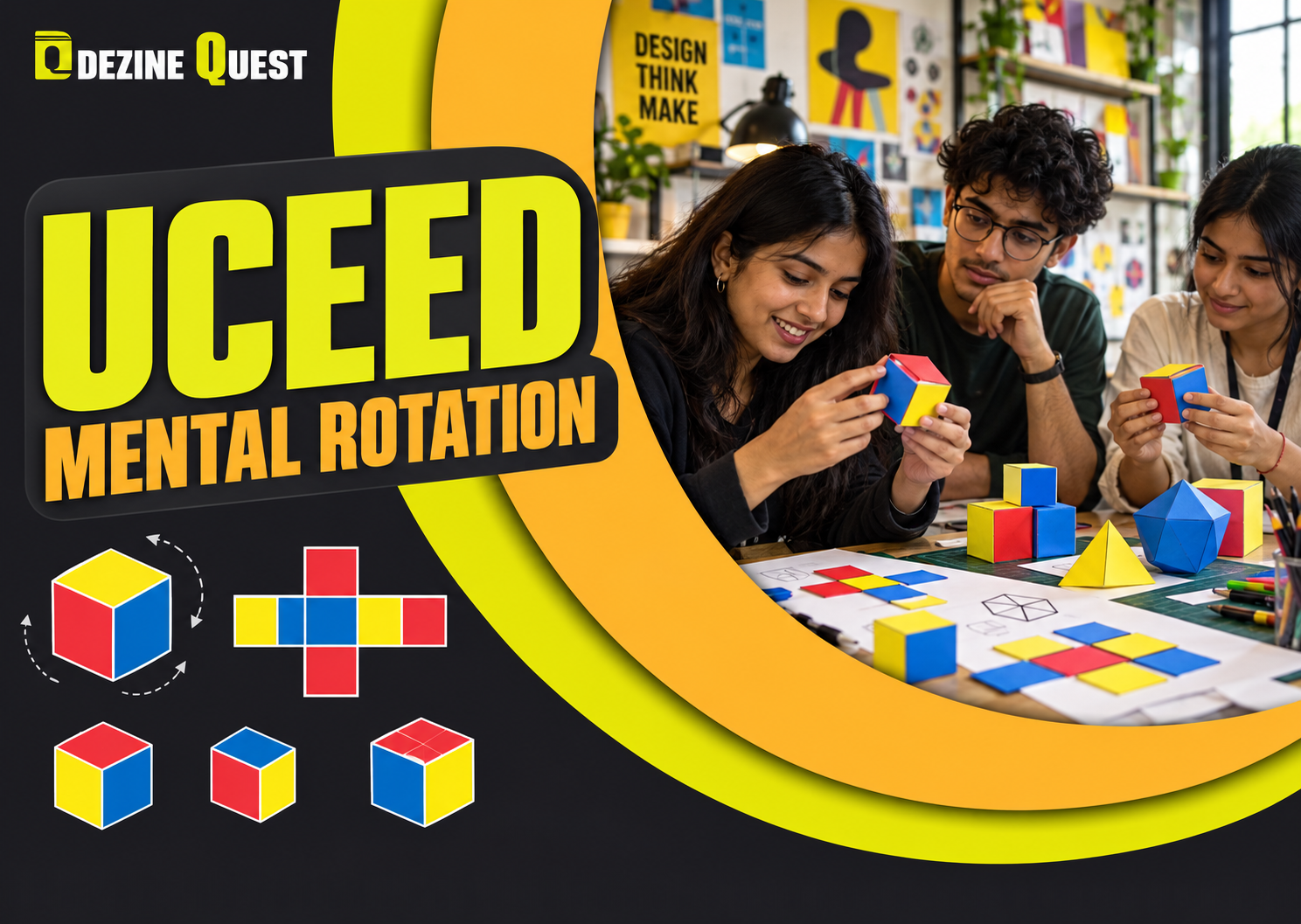
Imagine a cube painted on three sides. Now imagine turning it without touching it. Which coloured face would point upward? This small challenge captures the idea of mental rotation: the ability to picture an object moving in three-dimensional space while keeping its structure consistent. For design aspirants, this skill is valuable because it supports product thinking, object visualization and many spatial-reasoning exercises. It can be practised with a pencil, a few sheets of paper and ordinary household objects.
This guide focuses on one narrow skill rather than repeating a broad UCEED preparation guide. The exercises are educational practice methods, not predictions of any specific UCEED question.
What Mental Rotation Actually Means
Mental rotation is different from remembering how a familiar object looks. You must track the object's faces, edges and orientation as it turns. A letter printed on a cube does not magically switch to the opposite face when the cube rotates. The object's relationships stay fixed; only your viewpoint changes. This distinction helps students avoid guessing from surface appearance.
Start With a Physical Object, Then Remove the Object
Pick up a matchbox-sized carton or small cube. Mark three adjacent faces A, B and C. Rotate the cube ninety degrees and observe where each letter goes. Next, close your eyes and predict the same movement before checking. Finally, sketch the before-and-after views without using the cube. This three-stage progression—handle, imagine, draw—connects physical experience to internal visualization.
Exercise 1: Follow One Face at a Time
Many beginners attempt to rotate an entire complex figure in one mental step. Instead, identify one unmistakable feature: a marked corner, a hole, a stripe or an arrow. Predict its new position first. Then check the neighbouring features. When two choices appear similar, compare the order of adjacent faces. Rotation preserves adjacency, while a mirror image reverses it.
Draw a cube with a dot on the top face and a diagonal line on the front face.
Sketch the cube after a quarter-turn to the right.
Verify whether the dot and line remain on the same physical faces.
Repeat with a different axis of rotation.
Exercise 2: Build and Unfold Cube Nets
Draw six connected squares on paper, cut along the outline and fold the net into a cube. Label each face before folding. Ask which face lies opposite another and which three faces meet at one corner. Unfold the model and test your prediction. Try a second valid cube net and compare the arrangements. This builds an understanding of three-dimensional relationships that is difficult to gain from memorising answer patterns alone.
A useful self-check is to mark a single corner where three faces meet. After folding, those same faces must still share that corner. If your answer places two opposite faces together, reconsider the fold.
Exercise 3: Compare Front, Top and Side Views
Arrange two or three small boxes into a simple shape. Draw the front view, top view and right-side view as separate flat outlines. Rotate the arrangement and repeat. Notice how one view can hide an object that is obvious from another angle. This exercise is especially helpful for students who can sketch an attractive object but struggle to reason about what is concealed.
To increase difficulty, draw an arrangement for a friend and ask them to build it from the views alone. If multiple constructions are possible, discuss which information is missing instead of forcing a single answer.
Exercise 4: Spot Rotation Versus Reflection
Draw an asymmetric symbol, such as an L-shaped block with a small notch on one end. Make four variations: two rotations, one reflection and one deliberately altered shape. Identify which drawings could represent the original object after a real turn. Check the notch and the clockwise order of distinctive features. Reflection changes handedness; ordinary rotation does not.
Exercise 5: Try Paper Folding and Hole Positions
Fold a square sheet once, punch or mark a small dot near one corner and unfold it. Predict the final pattern before opening the paper. Increase to two folds only after the one-fold patterns feel intuitive. Work carefully: the result depends on the order and direction of folds. A hand-drawn fold sequence helps diagnose mistakes more effectively than memorising a gallery of patterns.
A Four-Week Spatial Reasoning Routine
Week 1 — Physical Rotation
Spend fifteen minutes per day rotating labelled boxes and sketching their positions. Record your most common error, such as confusing left and right or losing track of a marked face.
Week 2 — Nets and Views
Build three paper cube nets across the week. Add front, top and side views of simple household objects. Compare your prediction with the real model and correct the drawing in a different pen.
Week 3 — Timed Mental Practice
Begin with short sets of six to eight problems. After each set, explain why each incorrect option is impossible. Focus on adjacency, orientation and reflection rather than answering solely by visual intuition.
Week 4 — Mixed Transfer Tasks
Combine rotation, nets, folding and orthographic views in one practice session. End with a practical design task: sketch a desk organiser from two angles and show how its compartments would appear from above. The goal is to transfer spatial reasoning into communication, not simply improve a quiz score.
How to Track Progress Without Misleading Yourself
Keep a small table with the date, exercise type, number attempted, number correct and reason for each error. Accuracy matters, but so does the ability to explain the transformation. If you improve only on questions you have seen before, switch to unfamiliar shapes. Practice should develop flexible reasoning rather than recognition of repeated diagrams.
Common Mistakes in 3D Visualization Practice
Confusing a reflected shape with a rotated shape.
Forgetting that opposite cube faces cannot become adjacent.
Trying to memorise final images instead of following physical relationships.
Practising only on a screen without testing ideas with real objects.
Increasing speed before the underlying reasoning is reliable.
How This Fits Into UCEED Preparation
UCEED preparation includes visual and analytical thinking, and spatial exercises can be one useful component of a broader study plan. The exact current paper pattern, marking and question formats should always be checked in the official UCEED information brochure. Students considering UCEED coaching classes should look for practice that explains transformations, reviews errors and connects diagrams with real design situations.
Those comparing UCEED coaching classes online India can use the same checklist: Are students asked to explain their answers? Do sessions include feedback on mistakes? Is there a balanced plan for the other examination areas? The best format depends on the learner's schedule and gaps, not a universal claim that online or classroom teaching is always superior.
Learning Options at Dezine Quest
Dezine Quest offers design entrance preparation in Patna and describes UCEED coaching as covering visualization, spatial ability, observation and analytical reasoning. Its website also lists online classes. Students looking for design aptitude test coaching can review the available course pages and ask which current batch includes guided spatial-reasoning practice.
UCEED preparation: https://www.dezinequest.com/uceed-coaching-patna.html
Online class information: https://www.dezinequest.com/online-classes.html
Frequently Asked Questions
Can mental rotation improve without special software?
Yes. Paper cubes, small boxes, sketching and deliberate checking offer accessible ways to practise three-dimensional thinking.
Is this a complete UCEED preparation plan?
No. It develops one transferable spatial skill. A complete plan should follow the latest official syllabus and include the other relevant areas.
How much should a beginner practise each day?
Fifteen to twenty focused minutes can be a manageable starting point. Adjust the duration according to your overall study schedule and progress.
What if I keep confusing mirror images and rotations?
Use an asymmetric object with a coloured corner and compare its clockwise feature order before and after moving it. Check the prediction with a physical model.
Conclusion: Think in 3D, One Movement at a Time
Spatial confidence develops when you stop treating every shape as a guessing game. Rotate real objects, build paper nets, sketch multiple views and explain your mistakes. These simple habits can make mental rotation less intimidating and help you communicate product and space ideas more clearly. Explore Dezine Quest's current UCEED coaching options if you want a guided approach alongside independent practice.