
How to Improve Observation Skills for Design Entrance Exams: A Practical Guide for NIFT, NID & UCEED Aspirants
Many design aspirants spend most of their preparation time on sketching, aptitude and mock papers, but one skill quietly influences almost every creative task: observation. A designer must notice what other people overlook—proportion, behaviour, function, visual relationships, user problems and small details in everyday surroundings. For students preparing for NIFT, NID, UCEED and similar design entrance examinations, stronger observation can improve both idea generation and visual communication.
Why Observation Matters in Design Entrance Preparation
Observation is not the same as simply looking at an object. It means understanding what you see and identifying useful details. When a student observes a chair, for example, the exercise can go beyond drawing its outline. The student can notice its construction, material, balance, comfort, target user and possible usability problems. This analytical habit helps when an examination asks for visualisation, product improvement, storytelling or problem-solving.
1. Start a Daily Visual Journal
Keep a small sketchbook and record two or three things you notice every day. These can be objects, people in motion, shop displays, street signs, packaging, plants, vehicles or interesting arrangements of space. Add short notes explaining what attracted your attention. The purpose is not to create finished artwork; it is to train your eyes to notice shape, proportion, function and context.
2. Try the 60-Second Observation Exercise
Select an everyday object and study it carefully for one minute. Then remove it from sight and sketch or describe as many details as you can remember. Compare your result with the original object. Repeat this exercise regularly with increasingly complex subjects. It can improve visual memory as well as attention to detail.
3. Observe People and Their Interaction with Products
Good design responds to people. Watch how someone carries a bag, uses a bottle, waits at a counter, opens a door or interacts with a mobile device. Notice where the action appears effortless and where inconvenience occurs. Such observations can become valuable starting points for user-centred design ideas.
4. Break Objects into Basic Forms
When observing a complex object, identify the circles, cylinders, cubes, planes and curves hidden inside it. This makes drawing easier and develops structural understanding. It also helps students imagine the same object from a different angle, which is useful for perspective and visualisation exercises.
5. Study Negative Space and Composition
Do not focus only on the object itself. Notice the empty spaces around and between objects. Observe how elements are positioned within a frame and how the eye moves through a composition. Practising this can improve poster layouts, scene drawing, visual balance and presentation.
6. Compare Similar Products
Choose two objects that serve the same purpose—for example, two water bottles, chairs or packages. Compare their form, grip, material, visual appeal, portability and user experience. Write down what each design does well and what could be improved. Comparison develops design judgment without requiring memorised answers.
7. Practice Memory Drawing from Real Environments
Spend a few minutes observing a room, market, bus stop or classroom. Later, draw the scene from memory. Focus on placement, scale, people, objects and major visual relationships. Over time, this exercise can improve scene construction and the ability to retain useful visual information.
8. Convert Observation into Design Questions
After observing something, ask questions such as: Who uses it? What problem does it solve? What makes it difficult to use? Could it be safer, simpler, more sustainable or more accessible? This converts passive observation into design thinking and encourages original solutions.
A 7-Day Observation Practice Routine
- Day 1: Sketch five everyday objects using basic forms.
- Day 2: Observe and redraw three objects from memory.
- Day 3: Study people interacting with a public space and note usability issues.
- Day 4: Compare the design of two products with the same purpose.
- Day 5: Draw a familiar room or street scene from memory.
- Day 6: Pick one everyday problem and generate three design improvements.
- Day 7: Review the week’s journal and redraw your weakest observation exercise.
Common Mistakes to Avoid
Do not turn every observation exercise into a polished artwork. Avoid copying photographs without analysing the subject. Do not observe only attractive products—ordinary objects and everyday inconveniences often provide better design-learning opportunities. Most importantly, avoid judging your progress only by drawing quality; the goal is to improve noticing, understanding and communicating.
How Dezine Quest Can Support Design Entrance Preparation
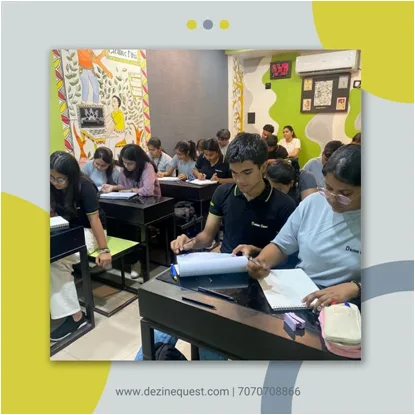
Structured practice can help students combine observation with sketching, aptitude, visualisation and creative problem-solving. Dezine Quest provides preparation support for design entrance examinations such as NIFT, NID and UCEED through practical assignments, concept development, mock practice and mentoring. Students can use guided feedback to identify gaps while continuing daily independent practice.
Conclusion
Observation is a trainable skill. A student who consistently studies objects, people, spaces and everyday problems gradually develops a richer visual memory and a stronger source of ideas. Instead of waiting for creativity to appear during an examination, build it through daily attention to the world around you. Small observation exercises, repeated consistently, can make design thinking clearer, faster and more relevant.
Frequently Asked Questions
How much time should I spend on observation practice daily?
Even 20 to 30 minutes of focused observation, sketching and review can be useful when practised consistently.
Can observation skills improve drawing?
Yes. Careful observation helps students understand proportion, structure, placement and details, which can make drawings more accurate and communicative.
Is observation important only for NID?
No. Observation and visual thinking can support preparation for several design entrance examinations, including NIFT, NID and UCEED, although each examination has its own current pattern and requirements.
What should I include in a visual journal?
Include quick sketches, object studies, user problems, interesting shapes, layouts, packaging, signs, colour relationships and short notes about why something caught your attention.
Suggested Internal Links
- NIFT coaching page
- NID coaching page
- UCEED coaching page
- Sample & previous-year question papers
- Test Series
- Contact / Enquiry page
Suggested CTA
Want to strengthen your creative thinking, sketching, aptitude and design problem-solving skills? Explore Dezine Quest’s design entrance preparation programs and structured practice support for NIFT, NID and UCEED aspirants.
Publishing Note
This draft is written as a fresh topic and is not copied from the existing Dezine Quest pages reviewed during preparation. Before publishing, verify any examination-specific pattern, eligibility, dates or syllabus details against the latest official notification.