
Perspective Drawing for Design Entrance Exams: How to Create Better Scenes for NIFT, NID & UCEED
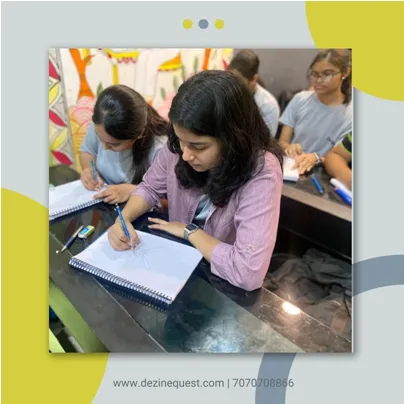
Perspective is one of the most useful foundations for an aspirant who wants to draw believable spaces, products and scenes. It helps a flat page communicate depth, distance, scale and viewpoint. Previous design entrance questions can also involve perspective and spatial understanding, so students preparing for NIFT, NID, UCEED and related examinations benefit from learning the logic behind perspective rather than memorising a few standard drawings.
Why Perspective Matters in Design Entrance Preparation
Dezine Quest provides preparation for NIFT, NID, UCEED and B.Arch, and its collection of previous-year material includes questions involving perspective, viewpoints and spatial relationships. Perspective practice therefore supports more than drawing quality: it can also strengthen visualisation and the ability to understand how forms change when the viewer or object moves.
1. Understand Eye Level First
Before learning multiple vanishing points, understand eye level. The horizon line represents the viewer's eye level in a perspective drawing. Objects above, below or crossing this line appear differently depending on the viewpoint. Practise drawing the same simple room from a low, normal and high eye level.
2. Master One-Point Perspective
One-point perspective is useful when the viewer faces a surface or space directly, such as a corridor, room, road or railway track. Start with boxes and simple interiors. Make receding parallel edges move toward one vanishing point. Once the structure is correct, add furniture, doors, people and other details.
3. Move to Two-Point Perspective
Two-point perspective is useful when a corner of an object or building faces the viewer. Practise cubes first, then convert them into shops, houses, furniture and product forms. Keep vertical lines controlled and use the two vanishing directions consistently.
4. Use Overlap and Size to Strengthen Depth
Perspective is not created only by construction lines. Objects that overlap others appear closer, and similar objects generally appear smaller as they move farther away. Combine these visual cues with vanishing-point logic to make scenes easier to read.
5. Add Human Figures for Scale
People help communicate the size of a space. Place figures at different distances while keeping their relationship to the horizon believable. Begin with simple stick or block figures and focus on scale and posture before adding details.
6. Practise Everyday Environments
Instead of drawing only empty boxes, sketch places you know: a classroom, café, bus stop, market lane, bedroom or railway platform. Real environments contain irregular objects, people and visual clutter, making them useful for learning how perspective works in practical scene drawing.
7. Learn to Change the Viewpoint
Draw the same object or scene from eye level, bird's-eye and low-angle viewpoints. This improves visual flexibility and helps students understand how viewpoint changes the emotional and spatial impact of a composition.
A 7-Day Perspective Practice Plan
- Day 1: Draw ten boxes in one-point perspective.
- Day 2: Create a simple room interior using one vanishing point.
- Day 3: Draw ten boxes and three buildings in two-point perspective.
- Day 4: Add people and furniture at different distances.
- Day 5: Sketch a street or market from observation.
- Day 6: Draw the same scene from a high and low viewpoint.
- Day 7: Complete one timed scene and review scale, depth and consistency.
How to Check Your Own Perspective Drawing
Ask whether receding edges follow a consistent direction, whether objects become smaller with distance, whether people fit the scale of the environment and whether the chosen viewpoint is clear. If something looks wrong, simplify the scene into boxes and construction lines to find the structural error.
Common Mistakes to Avoid
Common errors include placing unrelated horizon lines in one scene, using too many arbitrary vanishing directions, drawing distant objects too large, adding detail before establishing structure and forcing every edge to a vanishing point even when it does not belong there. Build the basic geometry first and refine later.
How Dezine Quest Can Support Drawing and Visualisation Practice
Dezine Quest's preparation ecosystem covers NIFT, NID, UCEED and B.Arch along with target, crash, studio test and situation-test programs. Structured assignments, drawing demonstrations, mock practice and feedback can help students identify whether difficulties come from perspective logic, observation, proportion, speed or presentation.
Conclusion
Perspective becomes easier when it is treated as a system rather than a trick. Start with eye level and simple boxes, then gradually introduce interiors, streets, people and unusual viewpoints. Consistent practice helps students create scenes that feel more believable while also strengthening spatial visualisation for design-oriented questions.
Frequently Asked Questions
Is perspective drawing important for design entrance exams?
Perspective can support scene drawing, spatial visualisation and viewpoint-based questions. The exact importance varies by examination and year, so students should follow the latest official pattern.
Should I learn one-point or two-point perspective first?
Start with one-point perspective to understand eye level and convergence, then move to two-point perspective for objects and buildings viewed from a corner.
How can I improve perspective drawing speed?
Practise simple boxes, rooms and street structures repeatedly before adding detail. Timed scene exercises can then help improve speed.
Do I need a ruler during practice?
A ruler can help when first understanding construction, but freehand practice is also valuable for developing confident exam-style sketching.
Suggested Internal Links
- NIFT Coaching page
- NID Coaching page
- UCEED Preparation page
- B.Arch Preparation page
- Previous Year Question Papers
- Online Classes page
- Test Series page
- Contact / Enquiry page
Suggested CTA
Strengthen perspective, scene drawing, spatial visualisation and other design entrance skills with structured practice and mentoring at Dezine Quest. Explore preparation programs for NIFT, NID, UCEED, B.Arch and related creative entrance examinations.
Publishing Note
This article is newly written and intentionally different from the earlier blogs on observation, visual memory, sketchbook practice, online preparation, material handling, limited-resource problem-solving, Indian crafts and portfolio storytelling. Any examination-specific syllabus, pattern, eligibility or dates should be verified from the latest official notification before publication.